At a Glance
Investors fund startups through direct checks, special purpose vehicles (SPVs), or committed funds.
A committed fund raises money upfront for many companies.
SPVs give limited partners (LPs) deal-by-deal choice. Funds give managers steady capital.
The best fit depends on deal flow (the deals you see), investors, cost, and post-close work.
What Are the Main Ways to Fund Startups?
For investors, startup funding is how capital buys equity, an ownership stake, in private companies. Founders also weigh bootstrapping (self-funding), Small Business Administration (SBA)-backed loans, and Regulation Crowdfunding, which lets companies sell small stakes online. Investors use three main routes.
Direct Angel Checks
An angel check is one person investing personal savings.
It adds one line to the cap table, the list of company owners.
Personal capital limits check size.
Syndicates and SPVs
An SPV is a legal entity that pools investors to make one investment.
An SPV lead forms the SPV and wires one combined check.
The lead may earn carried interest (carry), a share of profits.
Terms vary by deal.
Committed Funds
A committed fund, or blind pool, is capital LPs promise upfront.
LPs commit before the manager picks companies.
The general partner (GP) often earns a management fee for running the fund, plus carry.
How Do SPVs Compare to a Traditional Fund?
An SPV raises money for one deal. A fund raises once for a portfolio.
Factor | SPV | Committed Fund |
|---|---|---|
Capital commitment | Per deal | Upfront, for years |
LP choice | LPs pick each deal | GP picks every deal |
Manager economics | Varies by deal, often carry | Often a management fee plus carry |
Speed | Launches when a deal is ready | Starts after the fund closes |
Operating burden | Setup and tax reporting per vehicle | Ongoing accounting and reporting |
The tradeoff is deal-by-deal flexibility versus capital certainty. SPV managers raise capital for every deal.
When an SPV Fits Best
You are building a track record.
You run co-investments, where LPs invest beside your fund.
You hold pro-rata rights, the right to buy shares that keep your ownership.
You buy secondaries, existing shares bought from holders.
When a Fund Fits Best
You see steady deal flow.
Your LPs will commit long term.
You need fees to fund a team.
How Do Founders, LPs, and Counsel View Each Structure?
Market acceptance is each party's comfort with a structure.
Founders: An SPV can appear as one line on the cap table. Many managers find this keeps founder signatures and votes simple.
LPs: In practice, many LPs prefer to see each company before committing.
Counsel and co-investors: Many managers find lawyers and co-investors scrutinize poorly run SPVs. Late tax forms and wire errors reflect on the SPV lead.
What Should You Consider Before Choosing a Funding Structure?
Choosing a structure means matching deal flow to investor expectations. Key questions:
How many strong deals do you see each year?
Will your investors commit upfront or choose deal by deal?
How fast must you close?
Cost and Timeline
Fixed fees: A $10,000 fixed fee takes 2% of a $500,000 SPV and 0.5% of a $2 million SPV.
Close speed: In practice, slow closes can cost allocations, your share of a round.
Post-Close Obligations
Tax reporting: An SPV taxed as a partnership uses a Schedule K-1 tax form (K-1) to report each investor's share of income and deductions each tax year.
Distributions: Managers also handle distributions, the payouts after an exit, such as a company sale.
How Does Funding Differ by Startup Stage?
In practice, investor routes shift by stage.
Pre-seed: Angel checks and small SPVs.
Seed: SPVs and newer, smaller funds, often through co-syndication, where several leads share a deal.
Series A and later rounds: Funds often lead, and SPVs fill pro-rata allocations.
Late stage: Secondary SPVs buy shares in mature companies.
How Sydecar Helps SPV Managers
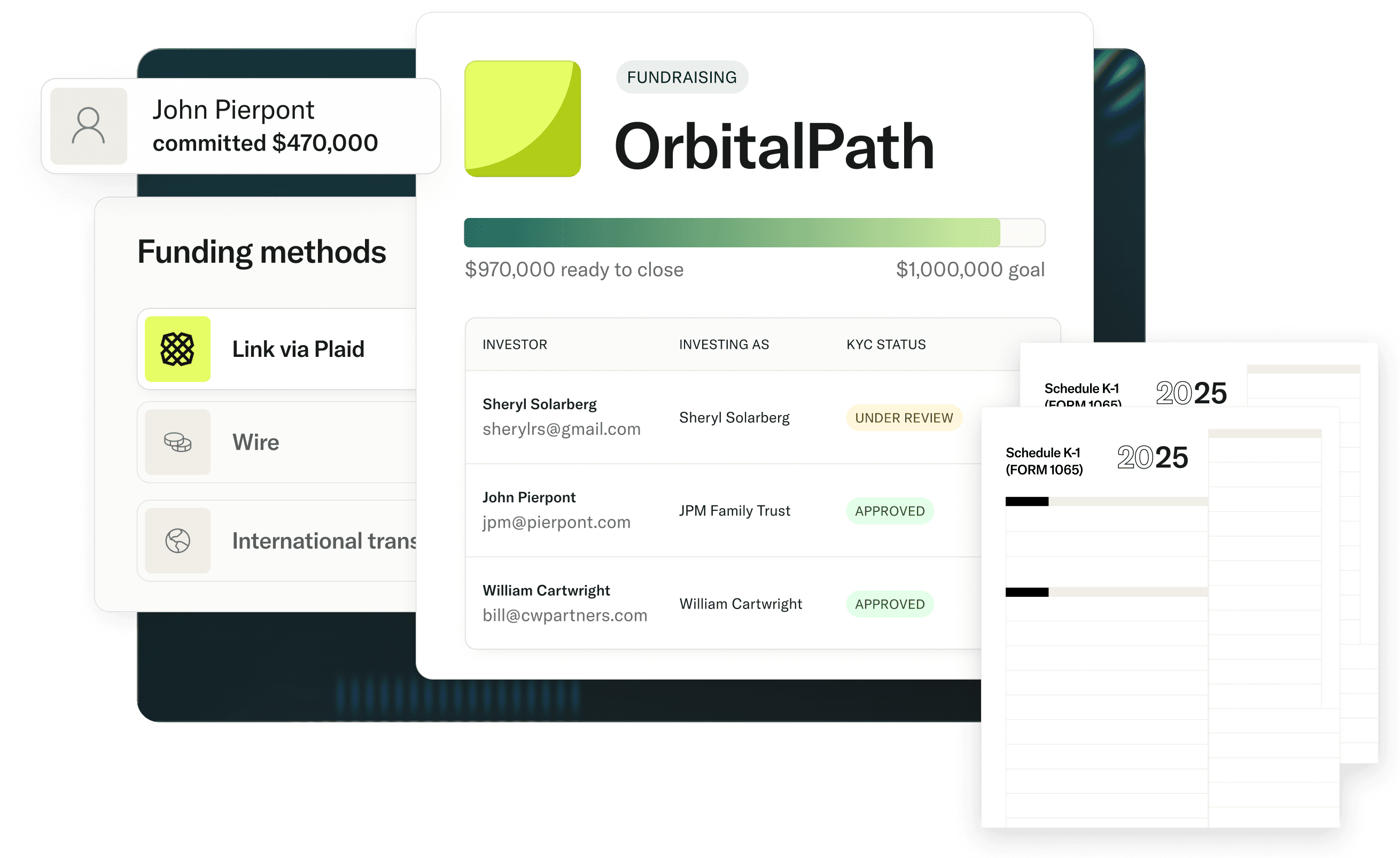
Sydecar is built solely for SPVs. It handles SPV formation and SPV administration, the ongoing back-office work.
Slow closes: Sydecar reviews SPVs within 4 hours of submission.
Edge cases: Every deal gets a dedicated Deal Operations Associate, a real person who knows the deal.
Small-deal costs: Pricing is one-time: 2% of capital raised, between $4,500 and $14,500, with no annual fees.
K-1 delivery: Track K-1 timelines per investor in the platform.
LP trust: Sydecar holds a System and Organization Controls (SOC) 2 Type 2 attestation, an independent security audit report, and runs no deal marketplace. LP data is never shared with other managers.
FAQ
How Much Does It Cost to Form an SPV?
It depends on the provider and the deal. Many providers charge a setup fee, and some add annual tax fees. Complex deals can cost more.
How Many Investors Can Join One SPV?
It depends on the SPV's legal exemption. Many SPVs rely on an exemption allowing up to 100 beneficial owners, the people who own a stake. A qualifying venture capital fund may have 250 if it has no more than $12 million in capital contributions and uncalled committed capital, per Securities and Exchange Commission (SEC) Release IC-35305. Uncalled committed capital is money promised but not yet collected. Managers typically confirm the limit with counsel.
Can a Fund Manager Run SPVs Alongside a Fund?
Yes. Many managers use SPVs for deals outside the fund's mandate or stated strategy. Fund documents often address allocation and conflicts.
How Long Does an SPV Take to Close?
Timelines vary by deal. They depend on investor count, document review, and wire speed. Many managers find late wires cause the longest delays.
Who Can Invest in an SPV?
Many SPV managers limit deals to accredited investors. The SEC defines them by tests such as net worth over $1 million, excluding a primary residence. Income of at least $200,000 ($300,000 with a spouse) in each of the two most recent years, with the same expected this year, also qualifies. Rule 506(c) requires every purchaser to be accredited and verified. Rule 506(b) allows up to 35 non-accredited purchasers in any 90-day period.