At a Glance
Investments in private companies are among the largest components of wealth for the top 0.1% of U.S. households, second only to stocks/mutual funds and ahead of real estate and durable goods.
Sydecar platform data show that investor activity in venture SPVs has changed: trusts are being used more frequently, there’s a growing presence from family offices and high-net-worth (HNW) investors, and larger checks are being written.
These investors are asking for access to a specific company or deal.
The advisors positioned well to meet this demand have back-office infrastructure that supports many types of deals and investors.
Introduction
Investments in private companies are among the largest components of wealth for the top 0.1% of U.S. households, second only to stocks/mutual funds and ahead of real estate and durable goods. This is according to Federal Reserve data cited by The Wall Street Journal. There are now roughly 430,000 U.S. households worth $30 million or more, and about 74,000 worth $100 million or more. They got there, in part, by owning equity in private companies.
Founders who sold equity in a pre-IPO round, executives with concentrated stock, athletes and creators setting up a family office for the first time, and other high-net-worth (HNW) clients are asking their advisors for direct access to private companies.
Three Changes to the Investor Profile
Sydecar administers venture SPVs for fund managers raising capital from individual and entity investors, many of whom are HNW. We analyzed our base of over 55,000 investor profiles and identified three patterns that stood out:
The entity behind the check is changing. In Q2 2026, trusts account for about 28% of Sydecar's entity investors, compared with 26% for LLCs. This is the first time trusts have overtaken LLCs as the most common entity structure. This suggests that family wealth is increasingly being structured to last across generations.
HNW asset thresholds are growing faster than the overall investor base. Investors with at least $5 million in total assets (one of the SEC’s accredited investor requirements) made up 1.8% of Sydecar's accredited investor base in 2022. In Q2 2026, that figure is 4.2%, more than double.
Check sizes have grown substantially. The median investor check on a closed Sydecar SPV increased 143% from 2022 to Q2 2026. Investors are committing more capital to specific opportunities they have already identified and want.
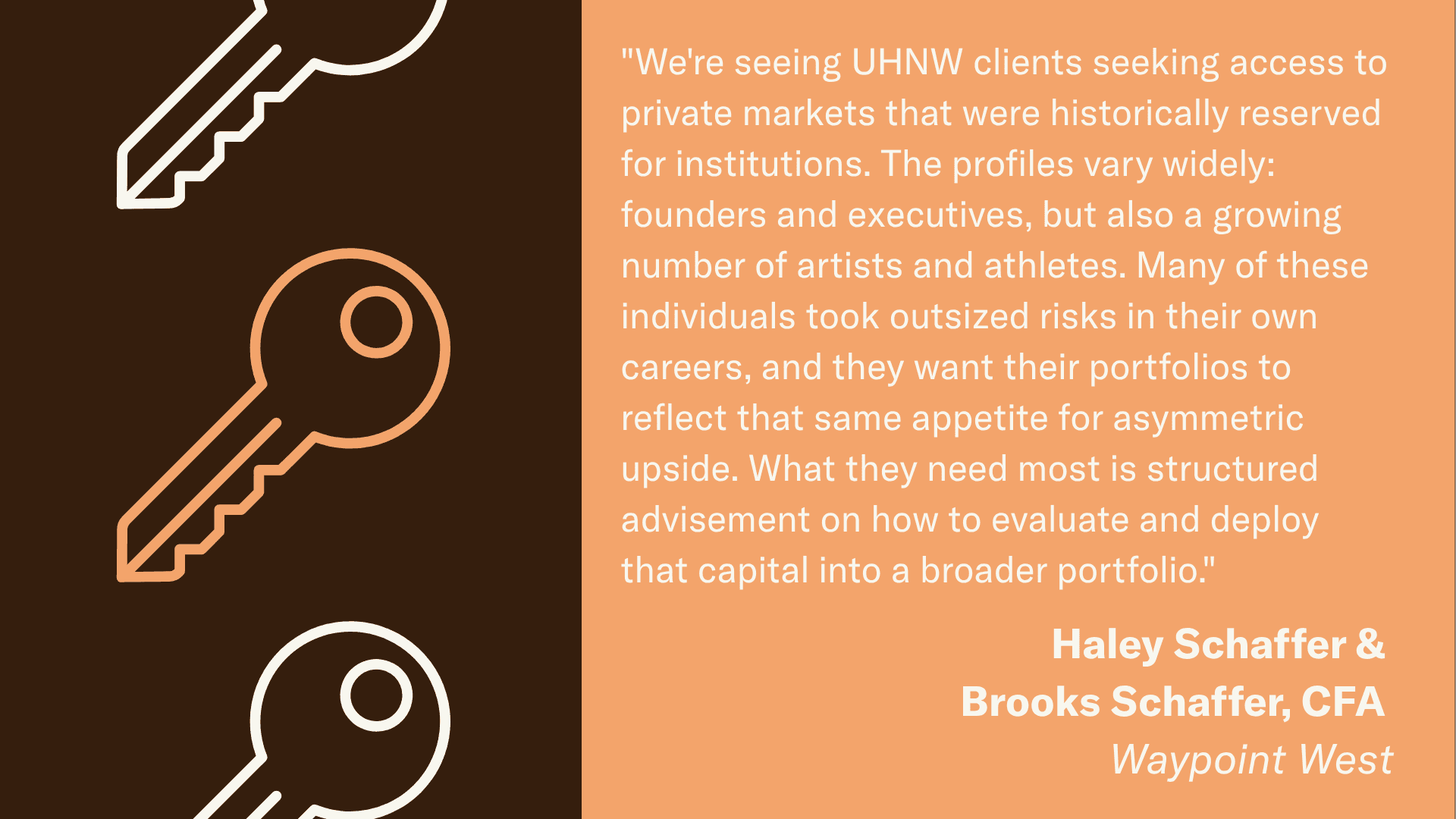
As more wealth creation occurs pre-IPO, the UHNW segment is increasingly looking for access to participate in ways that was historically reserved for institutions. Haley Schaffer and Brooks Schaffer, CFA, co-founders and managing partners of the independent wealth advisory firm Waypoint West, see this demand from UHNW clients firsthand:
What Investors Are Looking For
This investor already understands why private markets matter. What they want from an RIA is access to a specific deal.
A client wants exposure to a specific company they already know or a co-investment alongside a fund they trust. A blind pool, where investors commit capital before they know which companies they’ll receive exposure to, requires them to trust a manager's judgment across many companies they may or may not have heard of or want to invest in. A single-asset SPV, on the other hand, invests in a single company that is predetermined at the time investors commit. This allows them to opt in based on their own conviction about the company, rather than just blindly deferring to the manager’s judgment.
The advisors seeing the most traction here source deals themselves, conduct their own due diligence, and surface specific opportunities that they believe clients will be excited about. That is a meaningfully different role than recommending a diversified fund. The advisor puts together a single deal for their client and uses an SPV to allocate their client’s capital to the deal.
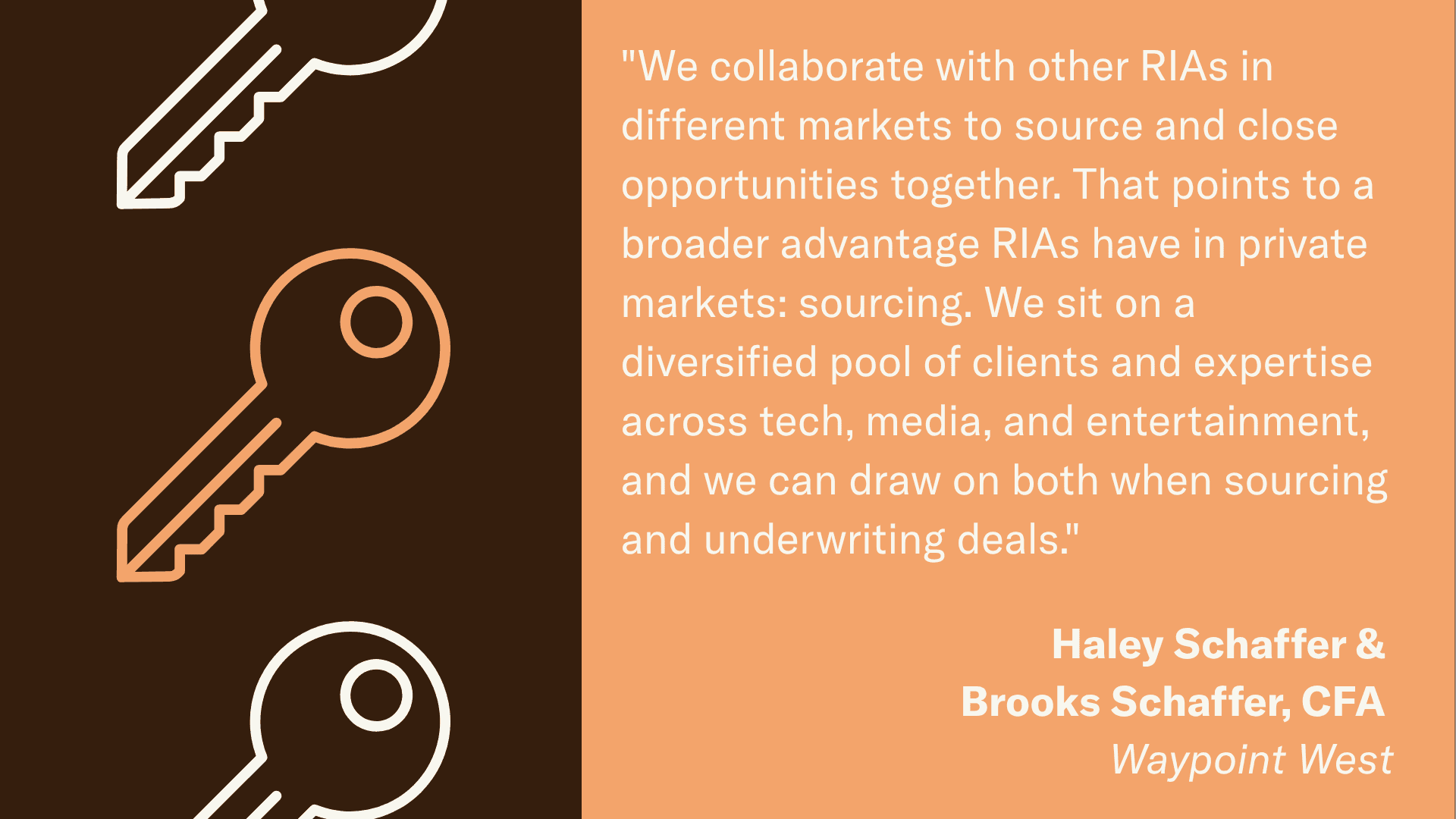
At Waypoint West, sourcing their own deals has meant partnering directly with other RIAs as well as tapping into their own client base:
The Infrastructure RIAs Need to Meet This Demand
A single SPV might need to support different investor profiles, ranging from individuals to trusts and family offices, each with different subscription documents, KYC requirements, and tax reporting needs. When an advisor's back-end cannot handle that mix adequately, closing the deal becomes a manual, error-prone process, which is consequently exactly where their clients expect the most rigor.
With Sydecar, an advisor identifies the company and then uses Sydecar to create the SPV that they will use to invest into the company. Sydecar generates the subscription documents suited to each investor's entity type, runs KYC and AML checks investor by investor, collects capital, and issues each investor the tax documents their entity structure requires, whether that is a K-1 for an LLC or the equivalent for a trust. In other words, the advisor sources the deal and manages the client relationship. Sydecar handles the paperwork.
This change in infrastructure is part of a larger change in what RIAs do for their clients. Read more about how advisors are moving from portfolio constructors to deal curators, and what that role requires operationally, in our related blog piece, “The RIA's New Role in Private Markets”: