At a Glance
Startup investing involves purchasing equity in early-stage private companies through vehicles such as Special Purpose Vehicles (SPVs) and venture funds.
SPVs offer deal-by-deal flexibility at lower cost. Venture funds support portfolio construction. Many fund managers use both.
Accredited investor requirements determine which vehicles and deal sizes are available.
Diversification and disciplined allocation are the primary tools for managing early-stage risk.
How Do Venture Managers Invest in Startups?
Venture managers choose between SPVs, funds, and direct investments based on how they raise capital and how many companies they back. Startup positions are illiquid and can take years to return capital, so the vehicle shapes both LP expectations and the manager's operating load.
SPVs. The manager, acting as general partner (GP) of the vehicle, sources a deal, sets its terms, and raises LP capital for that company only. LPs decide deal by deal.
Venture funds. LPs commit capital to the manager's strategy before specific companies are known. The manager deploys it across a portfolio over a set investment period.
Direct investments. The manager or firm writes a check into the company from its own balance sheet, with no pooled vehicle.
Many managers combine these. SPVs let them move on opportunities outside a fund mandate and give LPs direct exposure to specific companies. For independent managers, SPVs are the only vehicle, and each one builds the track record LPs evaluate.
Who Can Invest in Startups?
The Securities and Exchange Commission (SEC) requires most startup investors to qualify as accredited investors by meeting income or net worth thresholds.
Qualifies through | Individual criteria |
|---|---|
Net worth | Over $1 million, excluding primary residence, individually or with a spouse or partner |
Income | Over $200,000 individually or $300,000 with a spouse or partner in each of the prior two years, with the same expected this year |
Professional license | Series 7, Series 65, or Series 82 in good standing |
Role | Director, executive officer, or GP of the company selling the securities |
Entities with more than $5 million in assets or investments can also qualify.
The Regulation D exemption the SPV uses changes who can join and how the manager raises. Rule 506(b) bars general solicitation and allows up to 35 non-accredited investors with added disclosures. Rule 506(c) allows general solicitation, but every investor must be accredited, and the manager must take reasonable steps to verify it.
Common Investment Vehicles
Fund managers access deals through several structures:
Direct investments. Capital goes straight to the startup with no intermediary vehicle.
SPVs. A single-purpose entity pools investor capital for one deal.
Venture funds. Capital deploys across a portfolio of companies over a defined period.
Equity crowdfunding platforms. Online platforms allow smaller check sizes, often from non-accredited investors.
Should You Use an SPV or a Venture Fund?
Use an SPV to raise for and close one company at a time. Use a fund to deploy committed capital across a portfolio over several years.
Factor | SPV | Venture fund |
|---|---|---|
How capital is raised | Per deal, for one company | Committed up front, called over an investment period |
What LPs decide | Whether to back each specific company | Whether to back the manager's strategy before deals are known |
Sponsor economics | Carried interest, a share of profits, set per deal; some sponsors also charge a management fee | Annual management fee, often around 2% of committed capital, plus carried interest |
Administration cost | Varies by provider; some charge one-time fees and others charge annually | Ongoing fund administration, audit, and reporting costs |
Ownership of outcome | Each vehicle rises or falls with one company | Winners offset losses across the portfolio |
Common use | Deal-by-deal investing, co-investments, pro rata rights, secondaries | Portfolio construction for LPs who want a diversified, blind-pool commitment |
When Does an SPV Make Sense?
An SPV fits a manager with a defined investment thesis who raises from a concentrated group of LPs, such as high-net-worth individuals and family offices. Those LPs get direct exposure to specific companies. The manager builds a track record one deal at a time and can pair early-stage rounds with later-stage secondaries.
When Does a Fund Make Sense?
A fund fits a manager who wants committed capital to deploy across many companies over several years. Funds also suit LPs who prefer to back a strategy and let the manager pick the companies. Many fund managers still use SPVs for co-investments and deals outside the fund mandate.
How Do You Evaluate a Startup Investment?
Managers assess five factors before committing capital, then check how the instrument affects ownership.
Founding team. Track record, domain expertise, and ability to recruit.
Addressable market. Large enough to support a venture-scale outcome.
Business model. A clear path from product to revenue to margin.
Traction. Revenue, users, partnerships, or other evidence of demand.
Competitive position. A defensible advantage through technology, network effects, or switching costs.
Which Instruments Do Startups Use to Raise?
Instrument | How it works | When ownership is known | Common stage |
|---|---|---|---|
SAFE (Simple Agreement for Future Equity) | Converts to equity at a future priced round; no interest or maturity date | At conversion | Pre-seed, seed |
Debt that accrues interest and converts or is repaid at maturity | At conversion | Pre-seed, seed, bridge rounds | |
Priced round | Sets valuation and share price at close | At close | Seed onward |
Secondary purchase | Buys existing shares from employees or early investors | At close | Later stage |
SAFEs dominate pre-seed and seed rounds because they are simpler to negotiate.
How Do You Form and Run an SPV?
Forming an SPV requires five steps, from entity setup through post-close reporting. Venture rounds close quickly, so managers plan these steps before a term sheet arrives.
Form the entity. Most SPVs are Delaware LLCs, which pass gains and losses through to investors for tax purposes.
Set the terms. Prepare the operating agreement and subscription documents, including carried interest, fees, and any side letters with individual LPs.
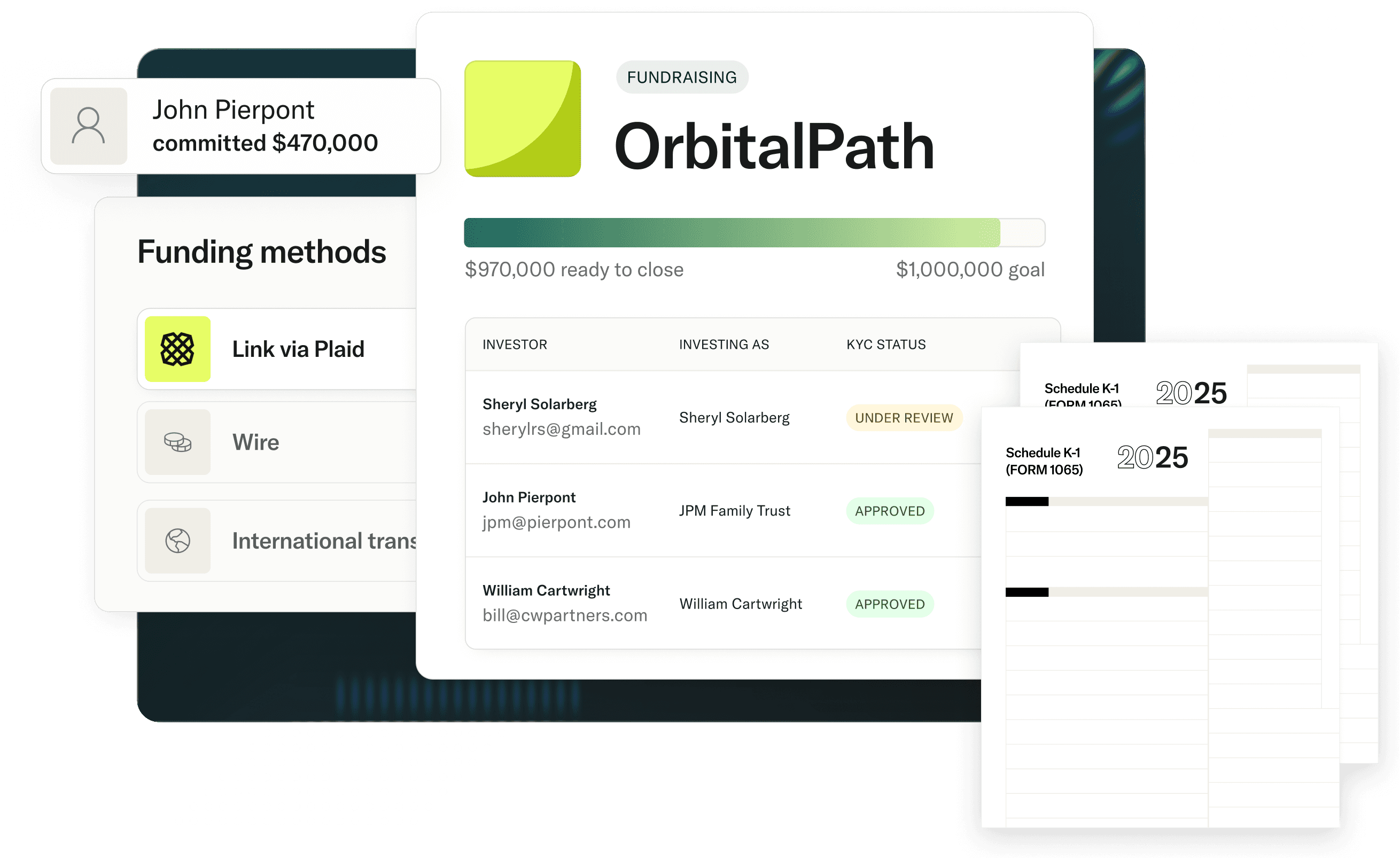
Onboard investors. Run Know Your Customer (KYC) and Anti-Money Laundering (AML) checks, verify accreditation, and collect signatures.
Collect capital and close. Receive LP funds and wire the investment to the company.
File and report. File Form D with the SEC, make Blue Sky filings in applicable states, and send each LP an annual K-1 tax form.
How Does Sydecar Support SPV Investing?
Sydecar is an SPV administration platform built exclusively for SPVs. Sydecar handles SPV formation and ongoing administration in-house and reviews SPV submissions within four hours. Every support interaction goes to a person who knows your deal.
The platform supports layered SPVs, pass-through vehicles, multiple closes, secondaries, side letters, and investor-specific fee structures. Pricing is one-time and published upfront, with no recurring annual fees. Sydecar is SOC 2 Type 2 certified and runs no deal marketplace. LP data is never shared with other managers, and Sydecar never markets to your LPs.
How Do You Manage Risk When Investing Deal by Deal?
Each SPV concentrates its LPs in one company, so managers manage risk across deals and help LPs size their exposure. Most startups fail, and a small number of outcomes drive most venture returns.
Diversify across deals. LPs who back 15 to 30 companies improve the odds that winners cover losses.
Size each position. Capping any one check at 5% to 10% of deployable capital limits the damage from a single loss.
Plan follow-ons. Raise a follow-on SPV to exercise pro rata rights in the strongest companies and protect ownership from dilution.
Match expectations to stage. Pre-seed carries the highest failure rates and return multiples. Later-stage secondaries carry lower risk and smaller multiples.
Frequently Asked Questions
How Quickly Can I Launch an SPV?
Timelines depend on the platform and deal complexity. On Sydecar, we review SPVs within four hours of submission, so managers can form a vehicle and onboard investors before a round closes.
What Is the Easiest Way to Create an SPV?
Use an SPV administration platform that handles entity formation, subscription documents, investor onboarding, and compliance filings in one place. Hiring a law firm and fund administrator separately takes longer and costs more to coordinate.
What Deal Types Can an SPV Invest In?
SPVs invest in primary rounds, secondary purchases of existing shares, and direct investments. More complex structures include layered SPVs, where one SPV invests through another, pass-through vehicles, and SPVs with multiple closes.
How Do I Verify That My Investors Are Accredited?
The method depends on the exemption. Under Rule 506(c), the manager must take reasonable steps to verify accreditation, such as reviewing income or net worth documentation or obtaining a third-party letter.
How Long Before I See Returns?
Startup investments can stay illiquid for five to ten years. Returns usually come through an acquisition or IPO, and secondary sales can offer earlier liquidity.
What Are the Tax Implications of Investing Through an SPV?
SPVs structured as LLCs are pass-through entities, so each investor receives an annual K-1. Qualified Small Business Stock (QSBS) exclusions may apply to certain gains. Investors should consult a tax advisor.
What Is the Difference Between a SAFE and a Convertible Note?
A SAFE converts to equity at a future priced round without accruing interest. A convertible note is debt that accrues interest and must convert or be repaid by maturity. SAFEs are simpler, which is why they dominate pre-seed and seed rounds.