Introduction
For years, VCs have used a standard 2% management fee and 20% carry, known as “2 and 20,” as the default structure for funds. There is no equivalent rule of thumb for SPVs, and terms have historically been more flexible. Emerging managers are diversifying fee structures as they adapt to new investor expectations, competitive deal environments, and the realities of running lean operations.
This report examines how managers are actually pricing their vehicles across stages, structures, and investor bases. The data, comprised of a set of SPVs raised on Sydecar between October 2024 and October 2025, reveals a market that values alignment and flexibility over tradition, with patterns that suggest where the industry is heading next.
Evolving Beyond 2 and 20
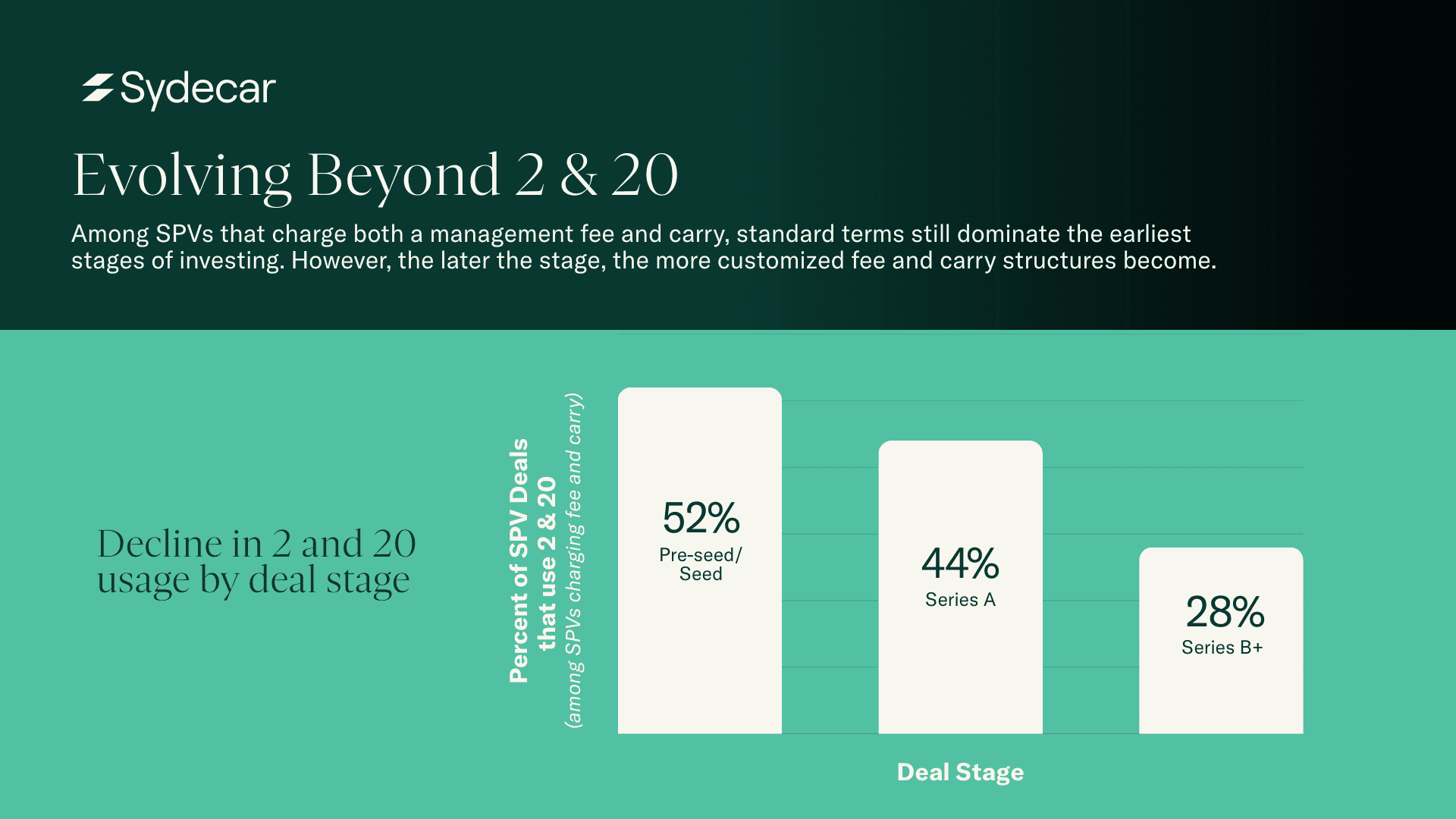
Standard terms still dominate the earliest stages of investing. Among SPVs that charge both a management fee and carry, over half of pre-seed and seed deals in the dataset used the traditional 2 and 20 structure, which offers the predictability that both investors and first-time SPV leads often prefer. Even at the Series A stage, about 40% of SPVs held to that model.
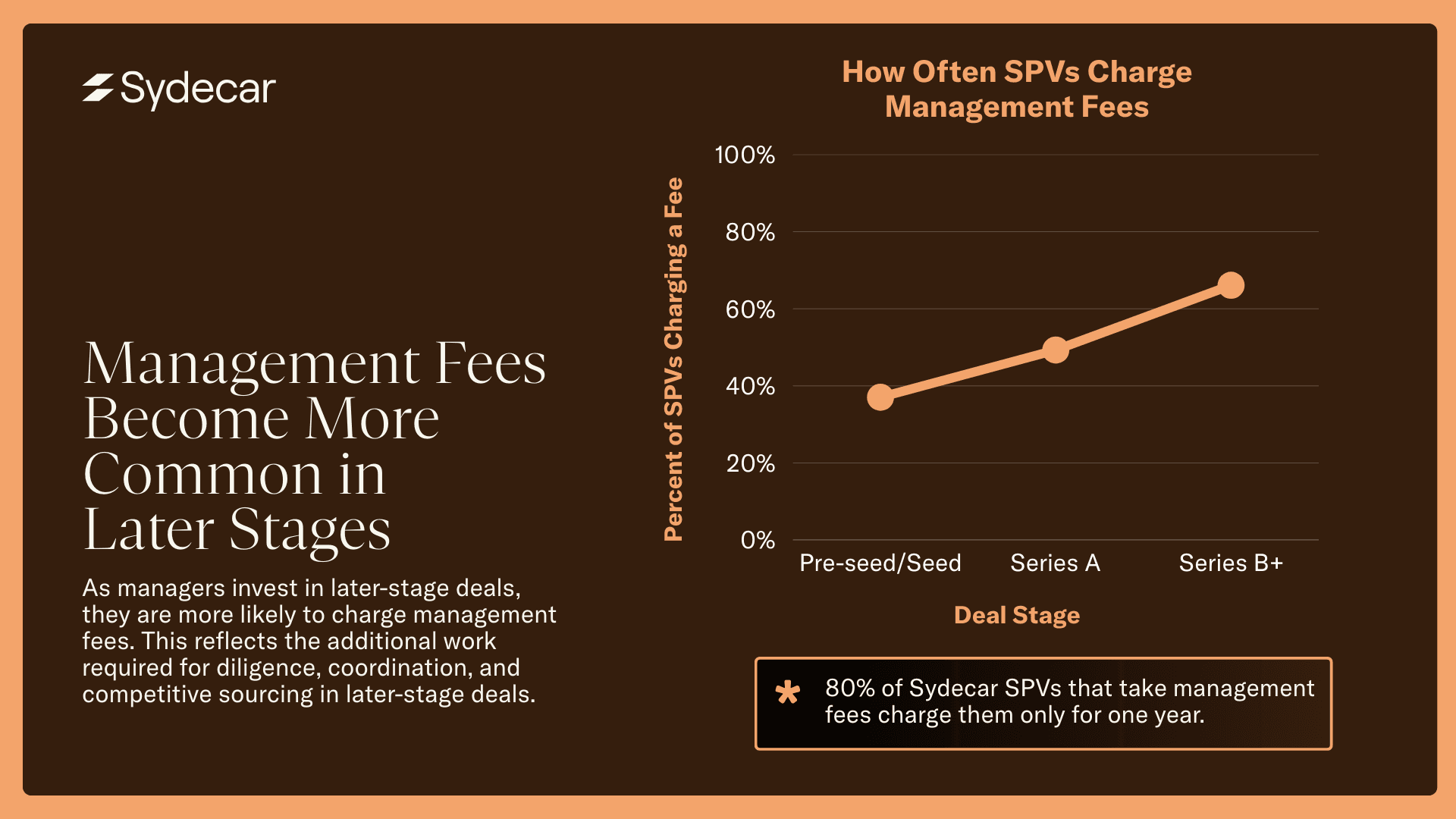
Management fees share a similar dynamic: Across all SPV deals, Sydecar managers charge a management fee over half of the time (53%). 2% is the most common rate across the dataset, reinforcing how entrenched that baseline remains even as other terms evolve.
But, as companies mature, managers are less likely to use standard terms. The later the stage, the more customized fee and carry structures become, reflecting growing diligence requirements, competitive entry points, and varying investor expectations. Using the familiar model can still be a trust-building strategy early on, but most managers quickly discover that one size doesn’t fit all.
Management Fees Become More Common in Later Stages
Some managers choose not to charge management fees on SPVs, since they do not actively manage capital in the same way a fund manager does. In some cases, managers are already earning management fees through a flagship fund and using SPVs to invest alongside it.
However, as managers invest in later-stage deals, they are more likely to charge management fees, which tend to be higher. This reflects the additional work required for diligence, coordination, and competitive sourcing in later-stage deals.
Across the industry, it's common for SPV management fees to be paid over a defined period, typically one to three years. On Sydecar specifically, 80% of SPVs that take management fees charge them only for one year. This approach aligns fees with the work required to complete and close the deal, rather than creating an ongoing obligation like a fund structure would.
20% Carry Is the Exception, Not the Norm
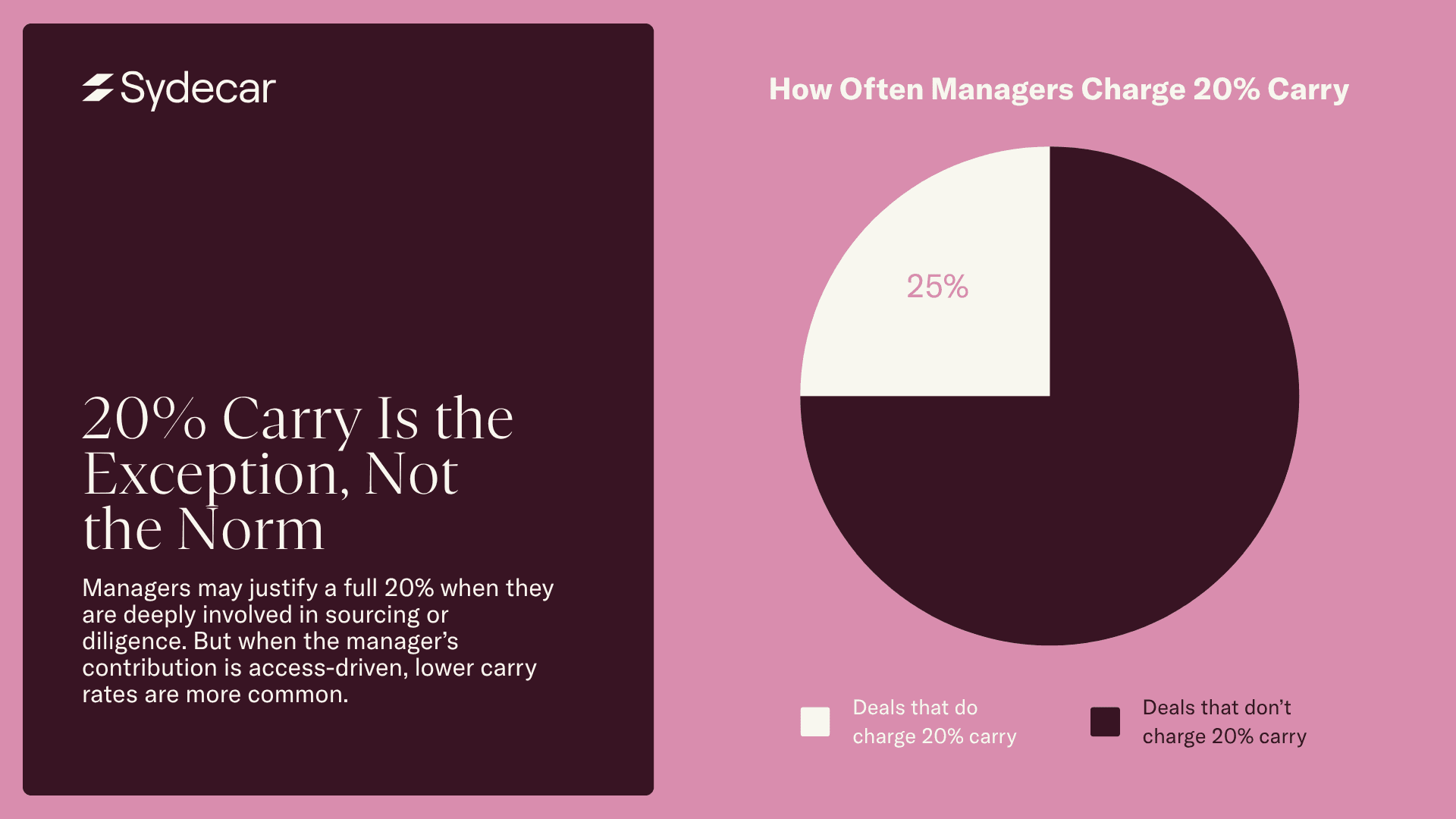
While 2% fees remain the most common baseline, carry is where real divergence appears. The average carry across all SPVs on Sydecar was 12%, with a median of 15%. Only a quarter of SPVs charged the traditional 20%.
This data reflects a market that aligns carry with the nature of the deal. Managers may justify a full 20% when they are deeply involved in sourcing or diligence. But when the manager’s contribution is access-driven – providing a bridge to an allocation rather than active oversight – lower carry rates are more common.
For emerging managers, reducing carry can also be a strategic lever for strengthening investor relationships, providing favorable economics to fund investors, encouraging repeat participation, or rewarding early LPs. The emphasis has shifted from enforcing a standard to optimizing for long-term trust.
Managers Raise Fees When They Do Not Take Carry
There’s little relationship between management fee percentage and carry percentage: the correlation between the two is 0.08, or effectively zero. In other words, higher fees do not correspond to higher carry, and lower carry does not imply lower fees. Instead, managers adjust each term to reflect the work required for a given deal.
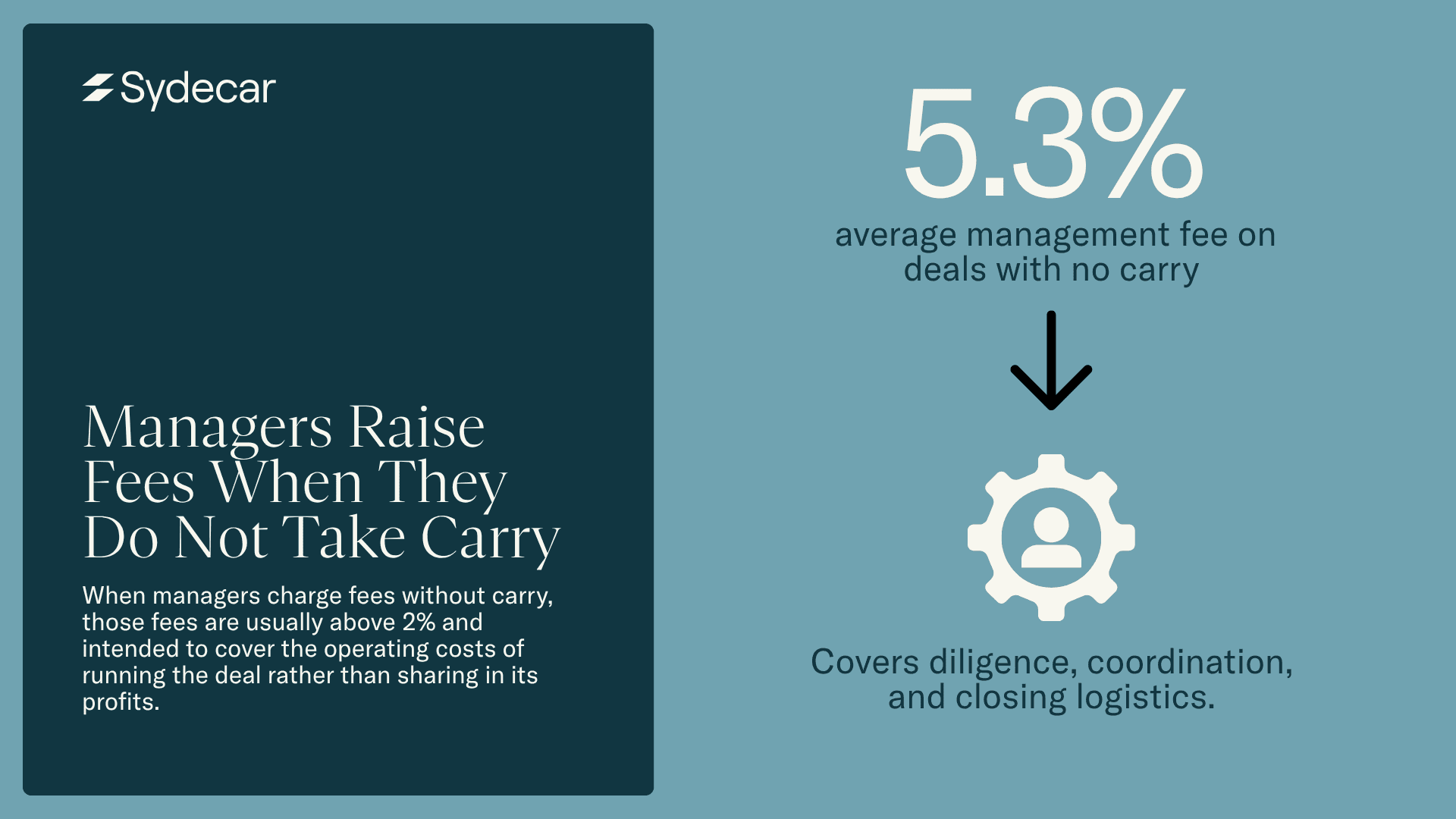
When managers charge fees without taking carry, those fees are on average 5.3%, well above the traditional 2%. The higher fees are intended to cover the operating costs of running the deal rather than sharing in its profits.
This indicates a shift toward modular pricing. Rather than treating fee and carry as two ends of a seesaw, managers design each independently to reflect their role in the deal.
More Complex Deals Use More Customized Terms
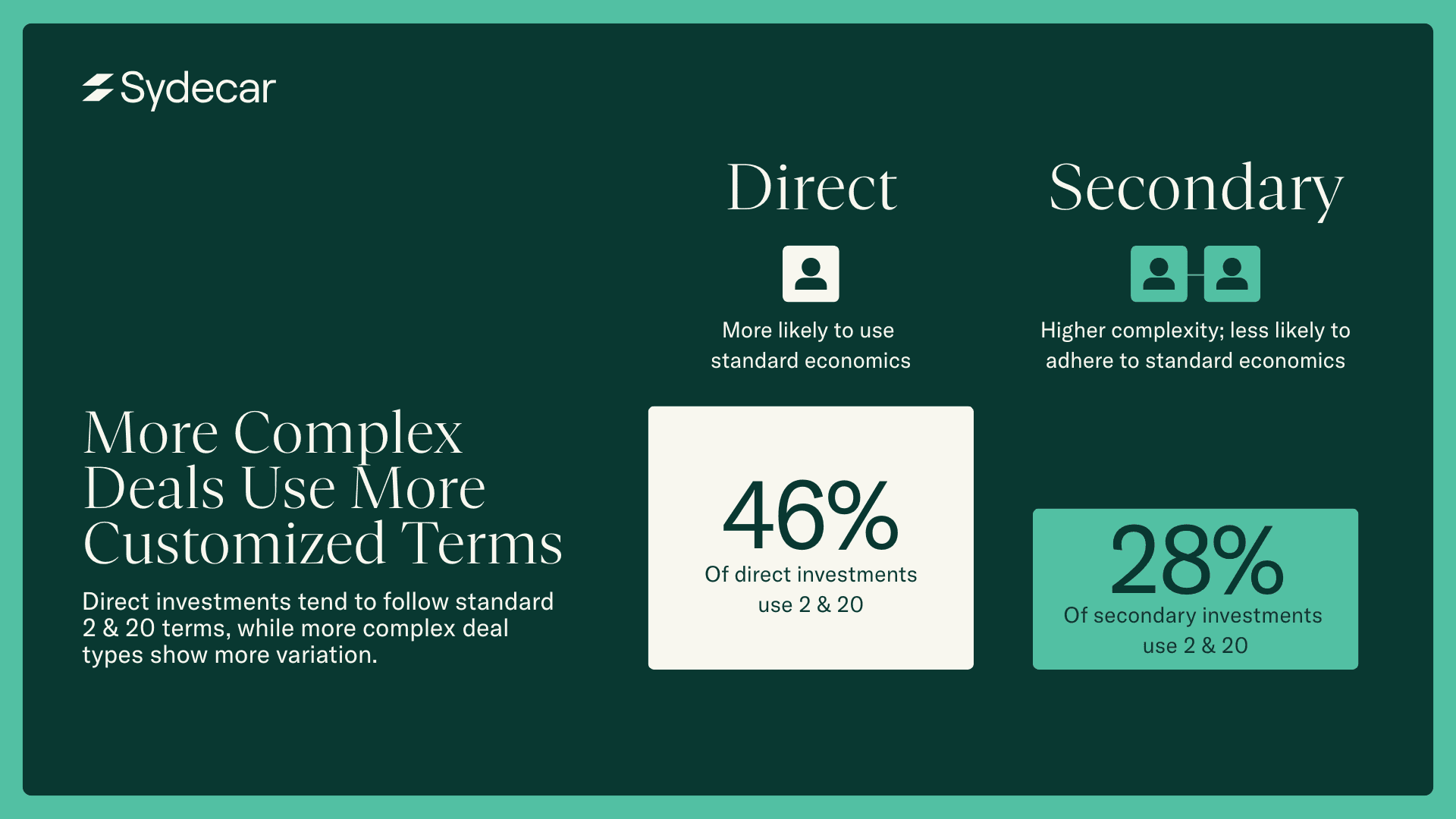
The way terms are set depends largely on the type of SPV being used. Direct investments still tend to follow standard terms—46% used 2 and 20—while only 28% of secondaries did. The latter typically demands more legal and administrative coordination, and its pricing reflects that complexity.
In layered and secondary SPVs, managers are more likely to adjust both fees and carry to account for additional diligence, multi-entity coordination, and liquidity constraints. This flexibility underscores the broader trend: managers are setting deal-specific terms, rather than sticking to a blanket formula.
A Market Defined by Adaptation
Across every stage and structure, one theme emerges clearly: SPV terms are no longer dictated by convention. The most successful managers treat fees and carry as levers for alignment, not assumptions to copy.
Standard terms still play an important role, particularly in the earliest stages where predictability helps to build trust, but as managers take on more complex or specialized transactions, bespoke structures are increasingly the norm.
For emerging managers, these benchmarks serve as a practical framework for setting expectations. Matching structure to effort, and economics to value, remains the most credible way to build investor confidence and sustain operational efficiency in an evolving private market.
To learn more about how Sydecar enables managers to launch SPVs with flexible economics, transparent pricing, and fast, compliant execution, book a demo with our team today: