At a Glance
Angel investors are high-net-worth individuals who invest personal capital into early-stage startups, typically writing checks between $25,000 and $500,000.
Angels evaluate founding teams, market size, early traction, and realistic valuations before committing.
Founders find angels through personal networks, pitch events, online platforms, and organized angel groups.
Syndicates pool capital from multiple investors using a Special Purpose Vehicle (SPV) to formalize each deal.
Angels move faster than venture capitalists (VCs) but contribute smaller amounts and less operational support.
What Is an Angel Investor?
An angel investor is a high-net-worth individual who provides early-stage capital to startups in exchange for equity or convertible debt (a loan that converts to equity at a later funding round). Angels invest their own money, make decisions independently, and back companies before institutional venture capital enters the picture.
Angels fill the gap between a founder's personal savings and a formal VC raise, typically at the pre-seed or seed stage when a company has a prototype or early revenue.
Angels range from solo operators to organized groups that review deals collectively. Syndicates take pooling further: a lead sources a deal and invites co-investors to participate through an SPV, a standalone legal entity created for a single investment.
What Do Angel Investors Look for in a Startup?
Angels evaluate five core factors before committing capital:
Strong founding team: Relevant experience, complementary skills, and a clear division of responsibilities.
Large addressable market: A market big enough for meaningful returns if the company executes.
Traction or proof of concept: A working product, early customers, or measurable engagement.
Realistic valuation: A valuation that reflects the company's stage and risk, not aspirational projections.
Clear path to the next milestone: A specific use for the capital and a plan to reach the next funding stage.
Approach angels with a working product, a defined customer, and a specific use for the capital.
How to Find and Connect with Angel Investors
Founders can reach angel investors through several channels:
Warm introductions: Mentors, advisors, and other founders provide the most effective path to angel funding.
Pitch events and demo days: Accelerator programs and startup competitions put founders in front of active angels.
Online platforms: Dedicated networks connect founders with investors, though founders should research each platform's terms and quality.
Angel groups: These organizations pool resources so members can participate in larger deals, often collectively investing $500,000 to $2 million per round.
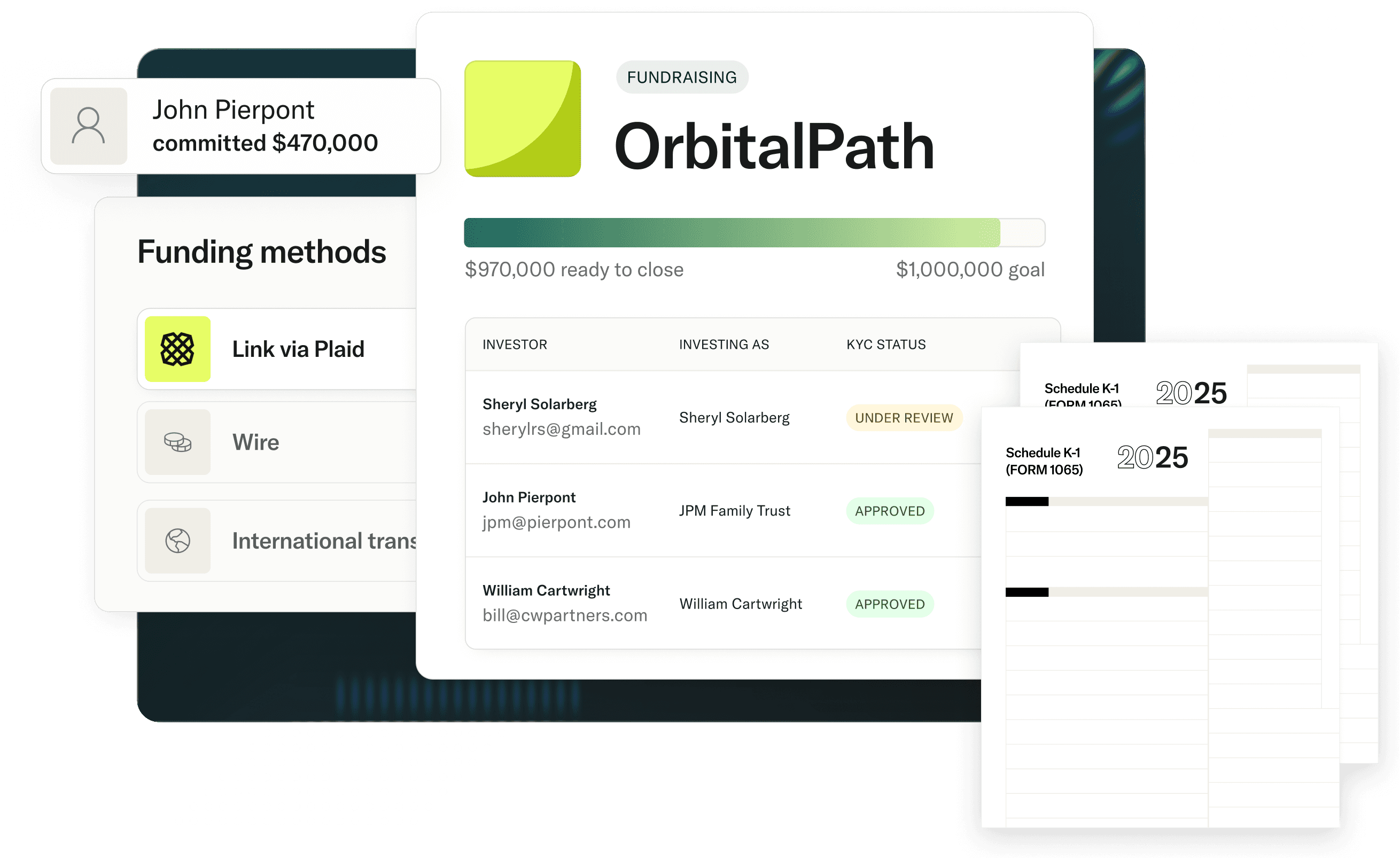
Syndicates use an SPV to hold each collective investment. The lead handles entity formation, investor onboarding, compliance (Know Your Customer, or KYC, and Anti-Money Laundering, or AML, checks), and annual K-1 distribution.
How Sydecar Supports Angel and SPV Investing
When an angel investor brings co-investors into a deal through an SPV, the operational complexity grows. Entity formation, compliance verification, investor onboarding, and tax filings all require time and infrastructure.
Sydecar is an SPV administration platform designed to address this problem. SPV leads can:
Launch SPVs in minutes with instant entity formation
Onboard investors digitally with a streamlined experience
Stay compliant with built-in KYC, Know Your Business (KYB), AML checks, and Form D filings
Deliver K-1s automatically at no additional cost
Sydecar charges 2% of capital raised per deal (minimum $4,500, maximum $14,500) with no hidden fees and no platform carry. SPV leads maintain full ownership of their investor relationships.