Introduction
Raising a new venture fund is harder than it has been in a decade: first-time fund closings in 2025 fell 80% from their 2021 peak (Pitchbook), and the median time to close a fund is the longest it’s been in ten years. And yet, 2025 was the third-largest year on record for global venture deployment at $425B (Crunchbase).
That tension points to a change in how capital reaches private companies: A growing group of professional, full-time venture investors now runs its entire strategy using SPVs. These investors build conviction in a company, then raise capital from a defined base of LPs for that specific deal, forgoing the traditional approach of raising a blind pool fund.
This shift aligns with what LPs want. LP interest in co-investing is rising, giving LPs direct exposure to individual private companies, lower blended fees, and enhanced returns (Pitchbook). That appetite is strong: 88% of LPs plan to put up to 20% of their portfolios into co-investments over the next five years (Adams Street).
SPVs give both sides what they want. With SPVs, managers can move at the speed of a specific opportunity: a vehicle can be spun up in minutes, with fees set for that particular deal. Managers can also support a barbell strategy through SPVs, giving them the flexibility to back early-stage primary deals all the way through late-stage secondaries, should they so choose. SPVs let LPs see and evaluate a deal before committing capital, so they can choose their exposure to specific companies.
This report examines a cohort of independent venture managers who raise capital exclusively through SPVs. We look at how much capital they raise, who they raise it from, and what types of deals they invest in.
Most of Sydecar's Largest Customers Operate Without a Fund
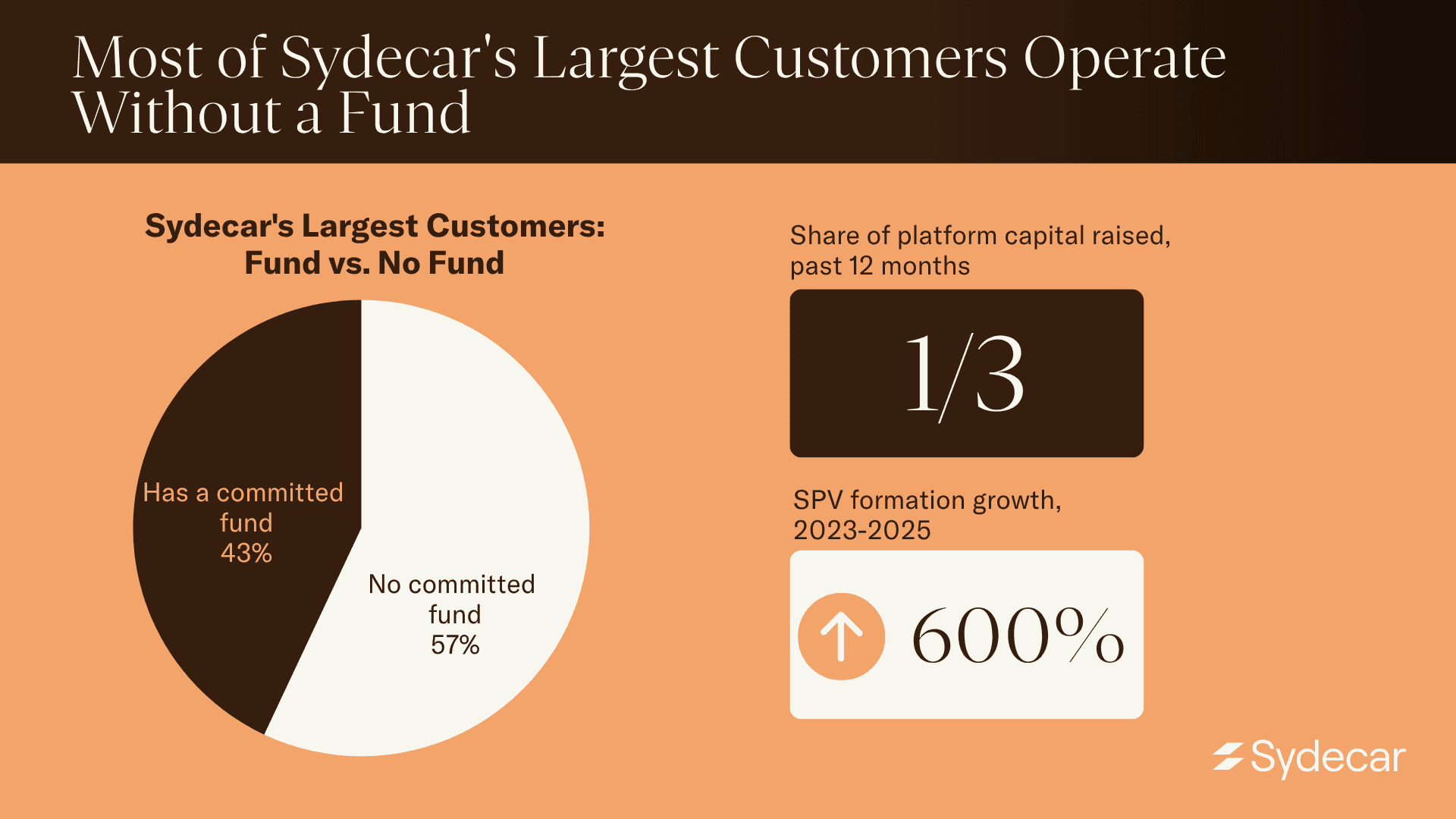
On Sydecar's platform, SPV formation increased by 600% between 2023 and 2025, driven largely by the platform's largest customers. Among these largest customers, 57% have no committed capital fund. Instead, they invest exclusively through SPVs on a deal-by-deal basis, and collectively account for roughly a third of all capital raised on Sydecar's platform over the past 12 months.
This segment raises bigger deals with more investors than any other on Sydecar, including managers who already run a committed fund. These managers are intentionally choosing deal-by-deal investing over a fund because of the speed, dynamic pricing, and scaling advantages SPVs offer, using them to operate at a scale that rivals a committed fund without ever forming one.
A Scale that Rivals Fund Managers
These independent venture managers raise an average of $2.1M per deal, from an average of 22 LPs, at an average LP commitment of nearly $100K. That deal size is more than double the average for Sydecar's fund manager segment. Independent venture managers have about 70% more LPs per deal, with an average commitment 46% higher than fund managers' LPs.
This large deal size and LP strength indicate that independent venture managers are not a fringe or experimental group. They represent a distinct, well-capitalized segment of the market: managers who have chosen not to raise a committed fund while still deploying capital at a scale that rivals managers who have.

These are not one-off allocations, either. 45% of LPs across independent venture manager deals have invested in more than one deal from the same manager, pointing to a base built on repeat participation rather than one-time checks.
Roughly a third of independent venture manager LPs invest through an entity. This includes entities such as family offices, IRAs, S-Corporations, trusts, and LLCs, with the latter two making up the largest share. LLCs and trusts are primarily used for liability protection, estate planning, or professional wealth management, and are usually set up for ongoing, professional investing rather than a single opportunistic check. This aligns with these investors' repeat participation: LPs who set up a dedicated investment entity are more sophisticated and likely to treat deal-by-deal investing as a standard part of their portfolio.

Deals Are Split Between Primaries and Secondaries, Concentrated in AI & Defense
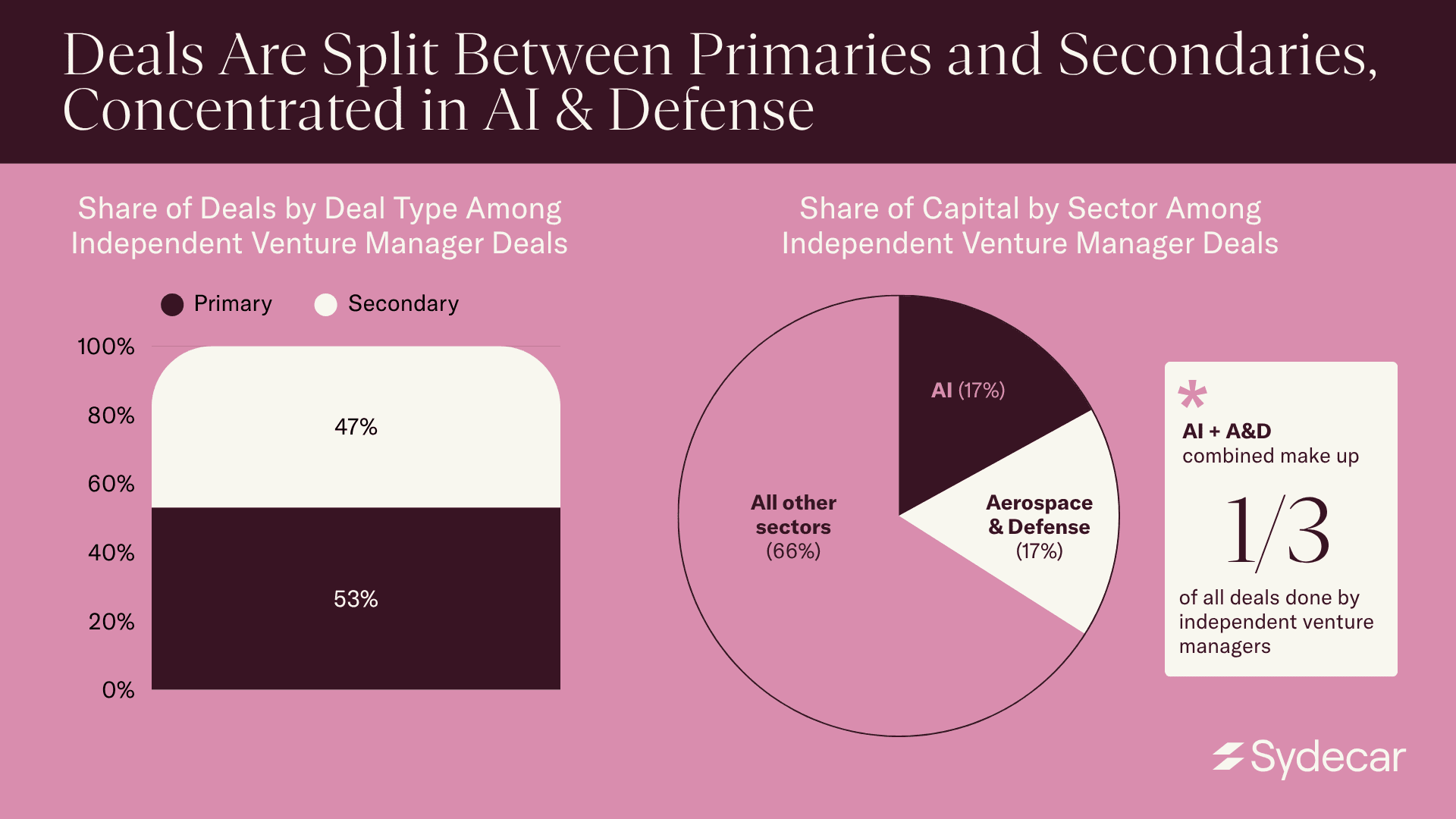
Among deals closed by independent venture managers, 53% are primary investments into a private company. The remaining 47% are secondaries. Because primary deals skew toward earlier-stage companies, while secondaries skew toward later-stage, high-demand names, the near 50/50 split suggests that deal-by-deal investors lean on a barbell investment strategy rather than limiting themselves to a specific deal type.
Aerospace & Defense and Artificial Intelligence each make up about 17% of independent venture manager deals, more than any other sector. Previous Sydecar data shows capital concentrating in these same two sectors, suggesting independent venture managers are drawn to where LP demand is highest.
A Permanent Strategy
While the data in this report compares deal-by-deal vs. committed capital fund investing, it is not intended to argue that one is better than the other. Both are legitimate, effective ways to invest into startup companies.
What the data does show, however, is that deal-by-deal investing has become a permanent strategy in its own right, not a stepping stone managers use to build a track record before raising a fund, as was long assumed.
To learn more about how this model works in practice, read our case study on how Sidelines built its investment strategy around deal-by-deal SPVs on Sydecar.